AeroFlux CFD is a high-performance finite volume solver engineered for massive parallel scalability, native GPU acceleration, and mathematical boundedness on unstructured grids.
AeroFlux CFD combines advanced computer science architecture with research-grade numerical solvers.
Integrated directly with PETSc and MPI. Employs a distributed matrix assembly pipeline, batched local element injections, and high-performance preconditioning (HYPRE, GAMG) to maximize core utilisation.
Offload dense linear system assemblies and solvers directly to accelerator cards. Supports modern HPC systems running either CUDA (NVIDIA) or HIP (AMD) stacks seamlessly.
Features Second-Order Upwind (SOU), QUICK, and Fromm schemes. Bounded with highly stable TVD limiters (vanLeer, Superbee, Minmod) to ensure shock-capturing stability and sharp scalar gradients.
Engineered to handle skewed, high-aspect-ratio, and non-orthogonal unstructured cells. Cell volumes, face vectors, and metric coefficients are calculated on a unified consistency engine across parallel ranks.
Fully integrated $k-\omega$ SST (Shear Stress Transport) wall-bounded turbulence model and $k-\epsilon$ high-Reynolds models. Correctly scales down to viscous sublayers ($y^+ < 1$) without singular point walls.
Applies Patankar’s mass-imbalance correction method. Resolves scalar divergence loops separately for inflow and outflow, preventing unphysical subcooling and stabilizing multi-physics thermal couplings.
Inspect, evaluate, and diagnose mesh quality for high-performance CFD simulations inside a high-fidelity volumetric environment.
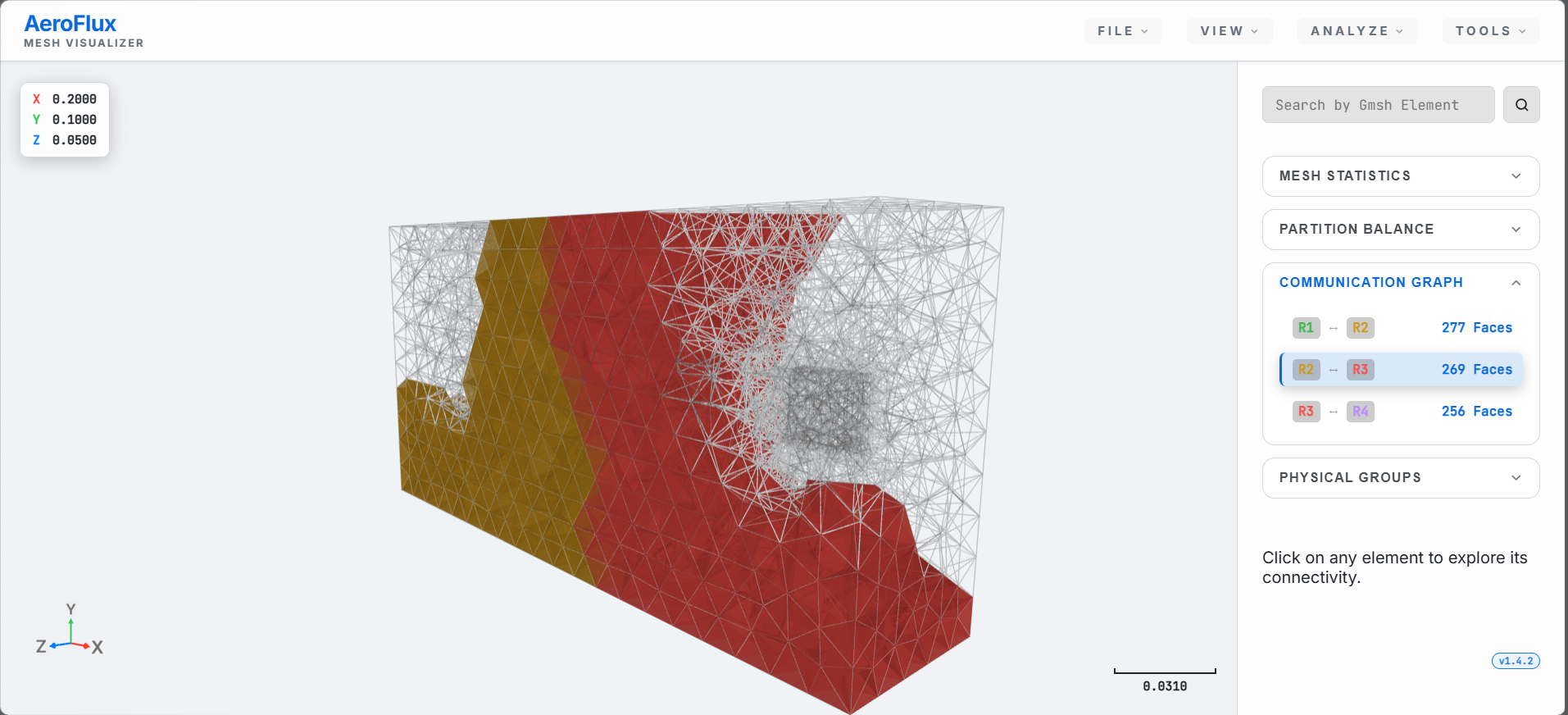
CAD-grade 3D element rendering using Three.js. Supports zoom, rotate, clipping planes, and cross-section analysis on complex unstructured grids.
Walk step-by-step through Cells, Nodes, Faces, and Neighbors. Double-click elements to center and check local indexing matrices on card & badge layouts.
Analyze cell quality (aspect ratio, skewness), cell volumes, computational zones, and parallel CPU partition bounds (MPI Rank mappings) with high-contrast gradients.
Analyze face-normal vectors and inter-processor communication graphs to debug load balancing and parallel MPI ghost-cell halo injections.
Examine computed AeroFlux results plotted directly against exact analytical configurations and peer-reviewed benchmark data.
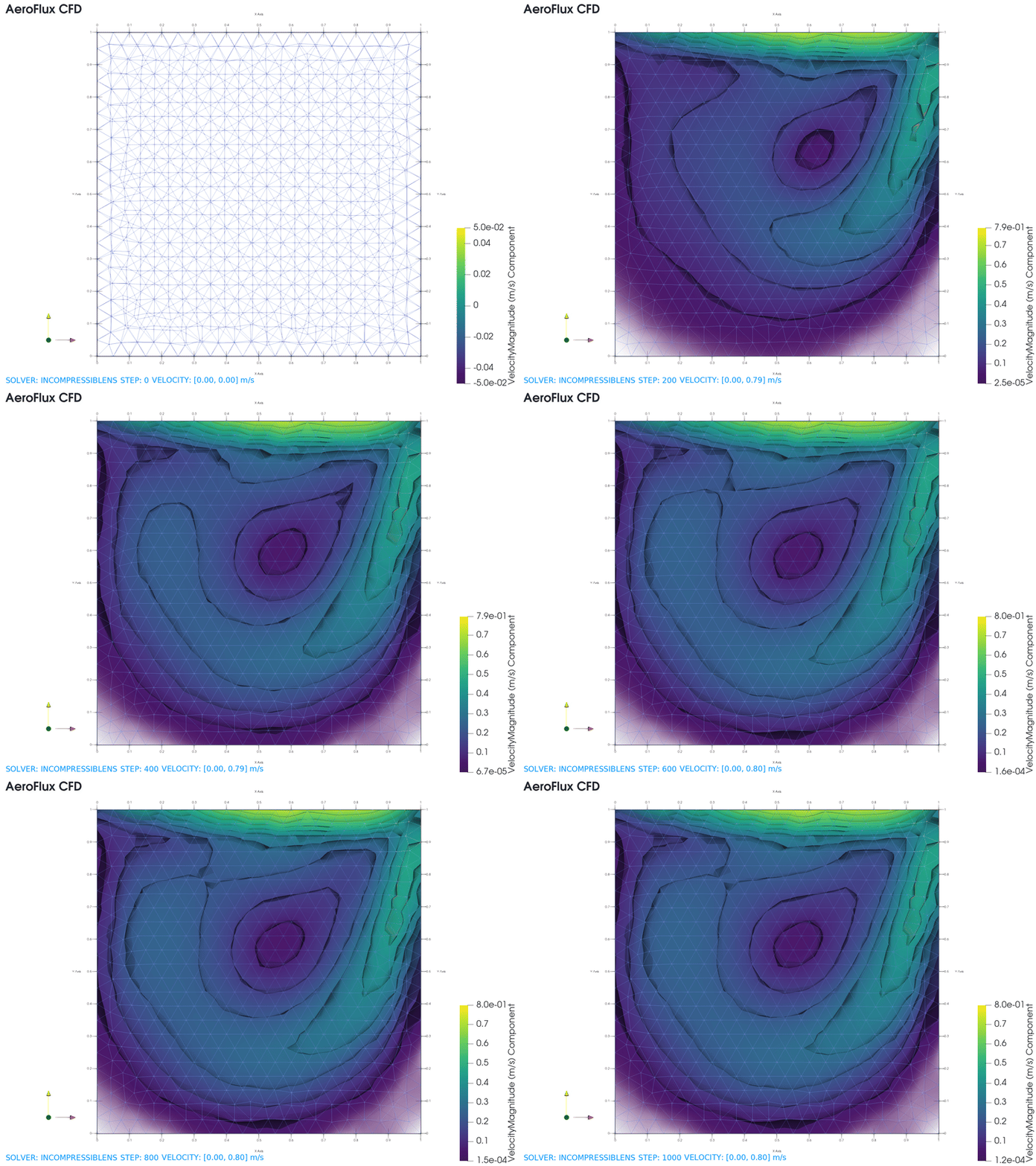
This benchmark validates exact mass conservation and multi-dimensional momentum diffusion inside a fully enclosed 3D volume. The fluid is driven solely by the shear stress exerted by a moving top boundary wall.
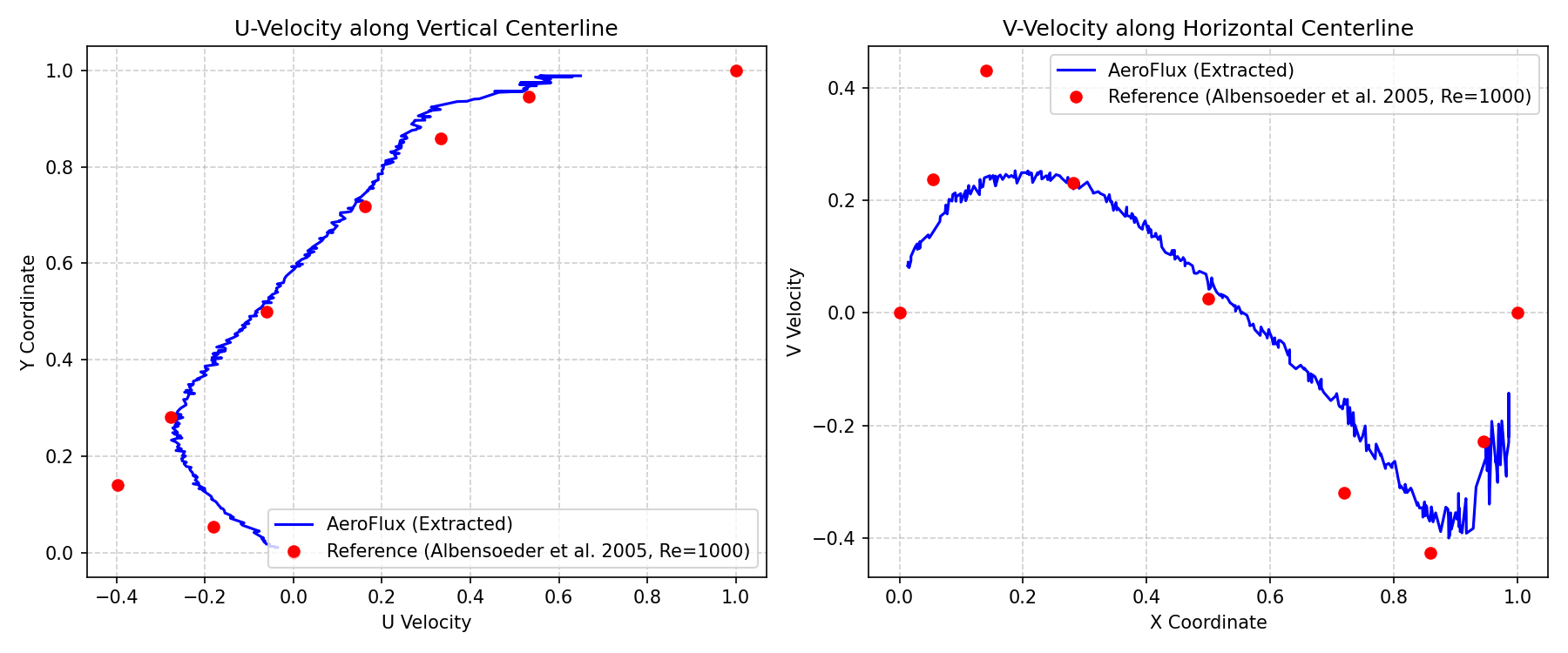
Result: Centerline velocity profiles computed on our unstructured solver align perfectly with the classic spectral benchmark solutions published by Albensoeder et al. (2005), illustrating the reliability of the cell-centered collocated FVM pressure-velocity formulation.
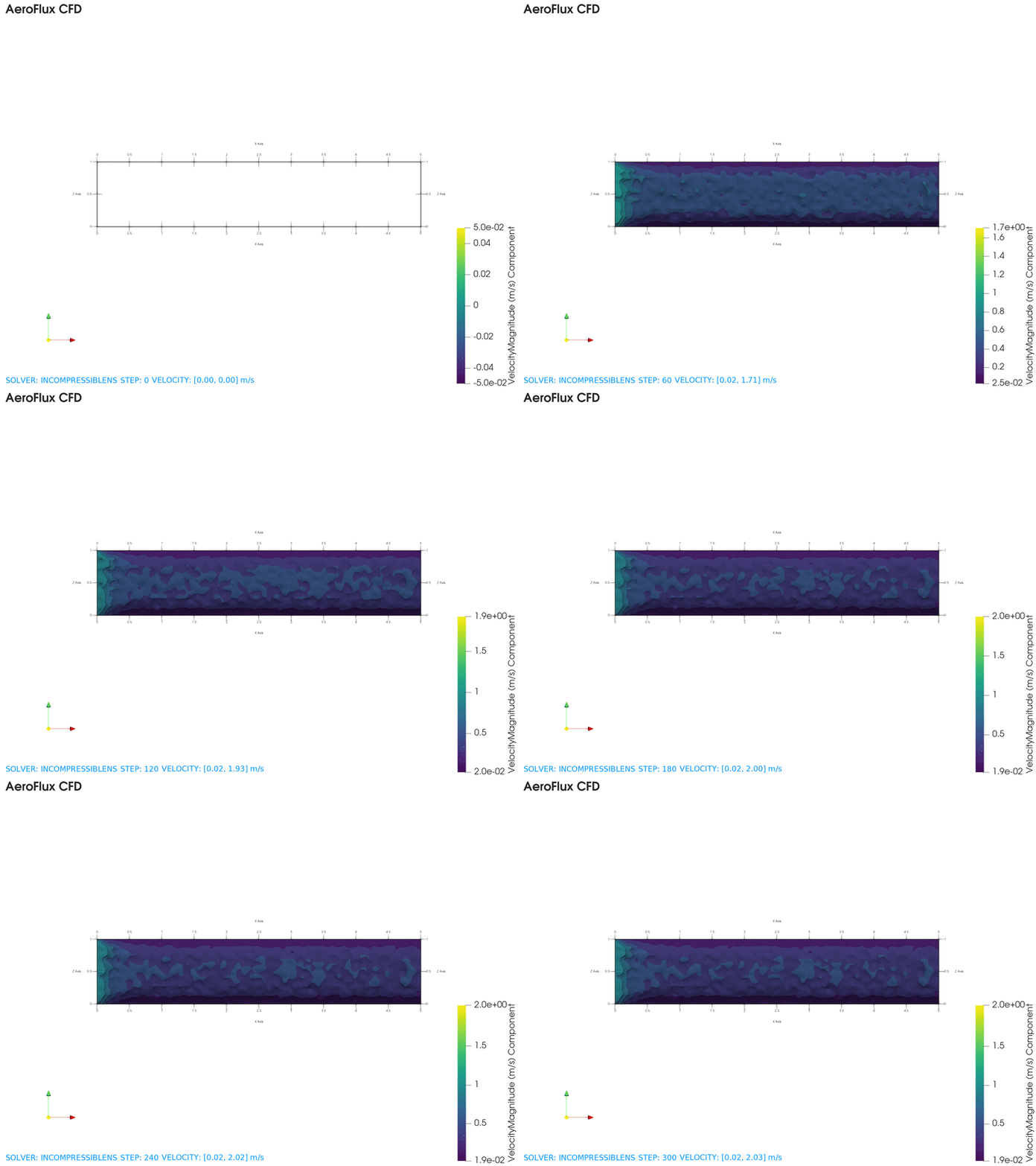
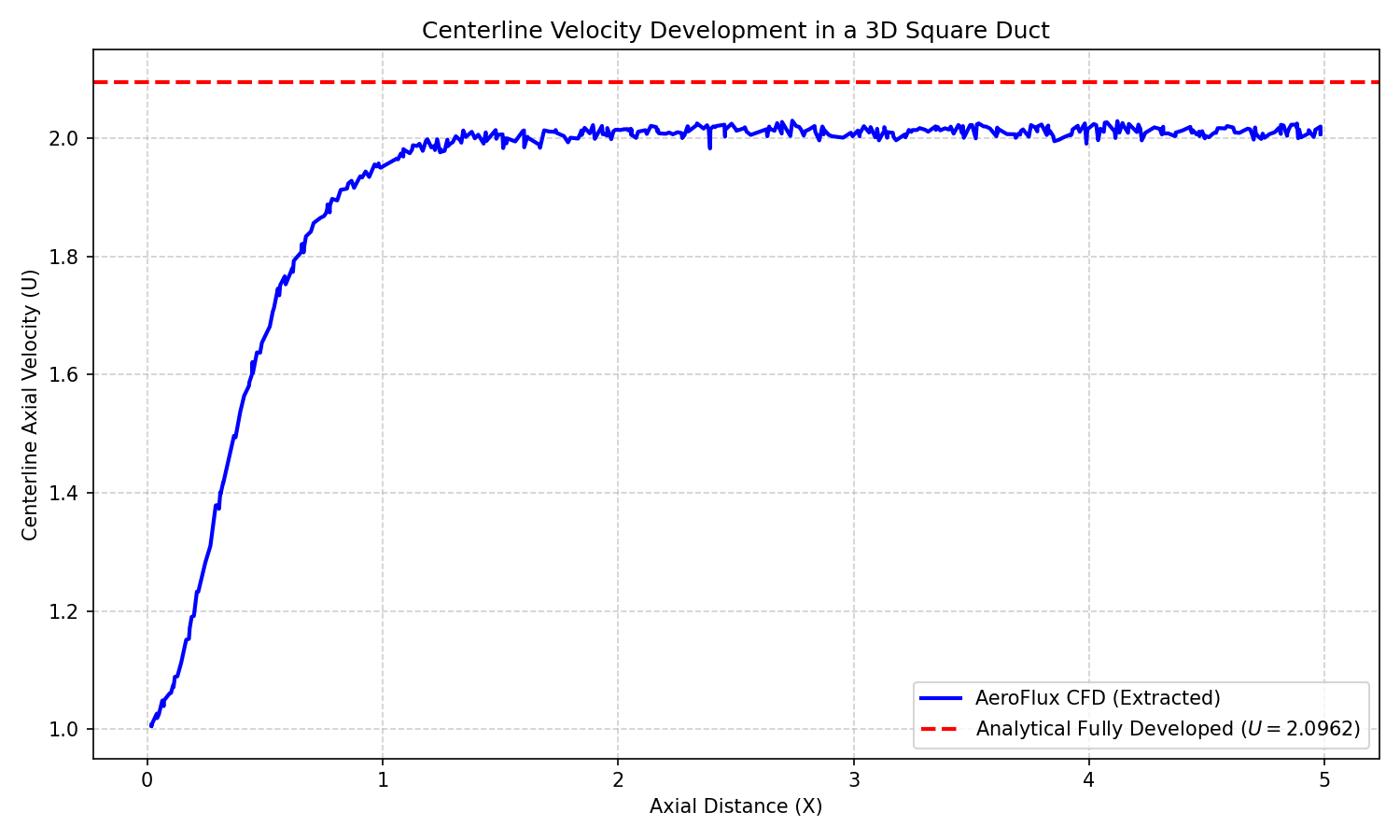
Demonstrates viscous development inside a square channel. A uniform inflow boundary condition develops downstream into a fully three-dimensional parabolic velocity profile due to boundary layer drag along the four no-slip walls.
Result: AeroFlux spatial developing profiles asymptotically approach the exact analytical Fourier series solution, verifying the second-order viscous diffusion operator and non-orthogonality metric formulations.
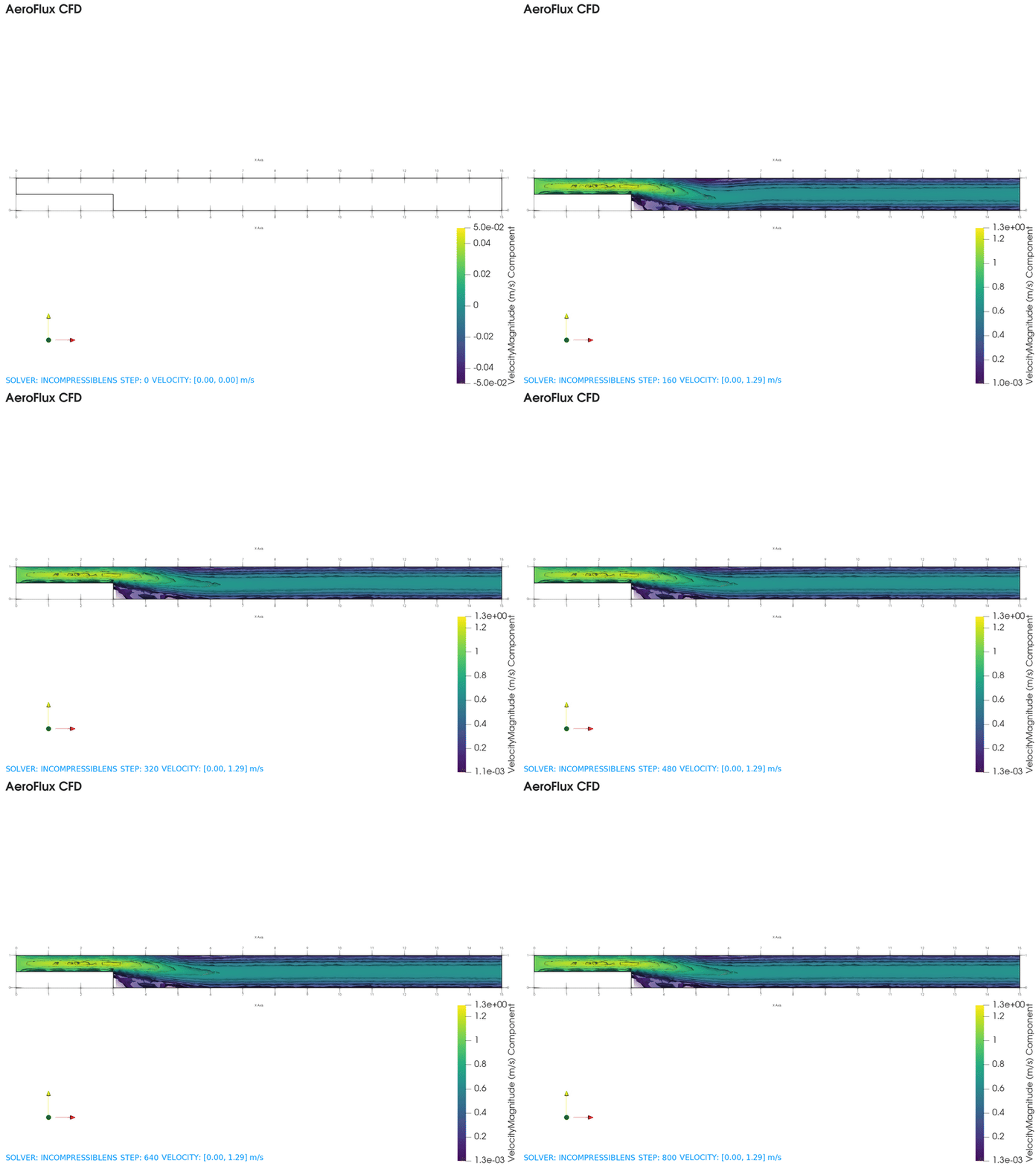
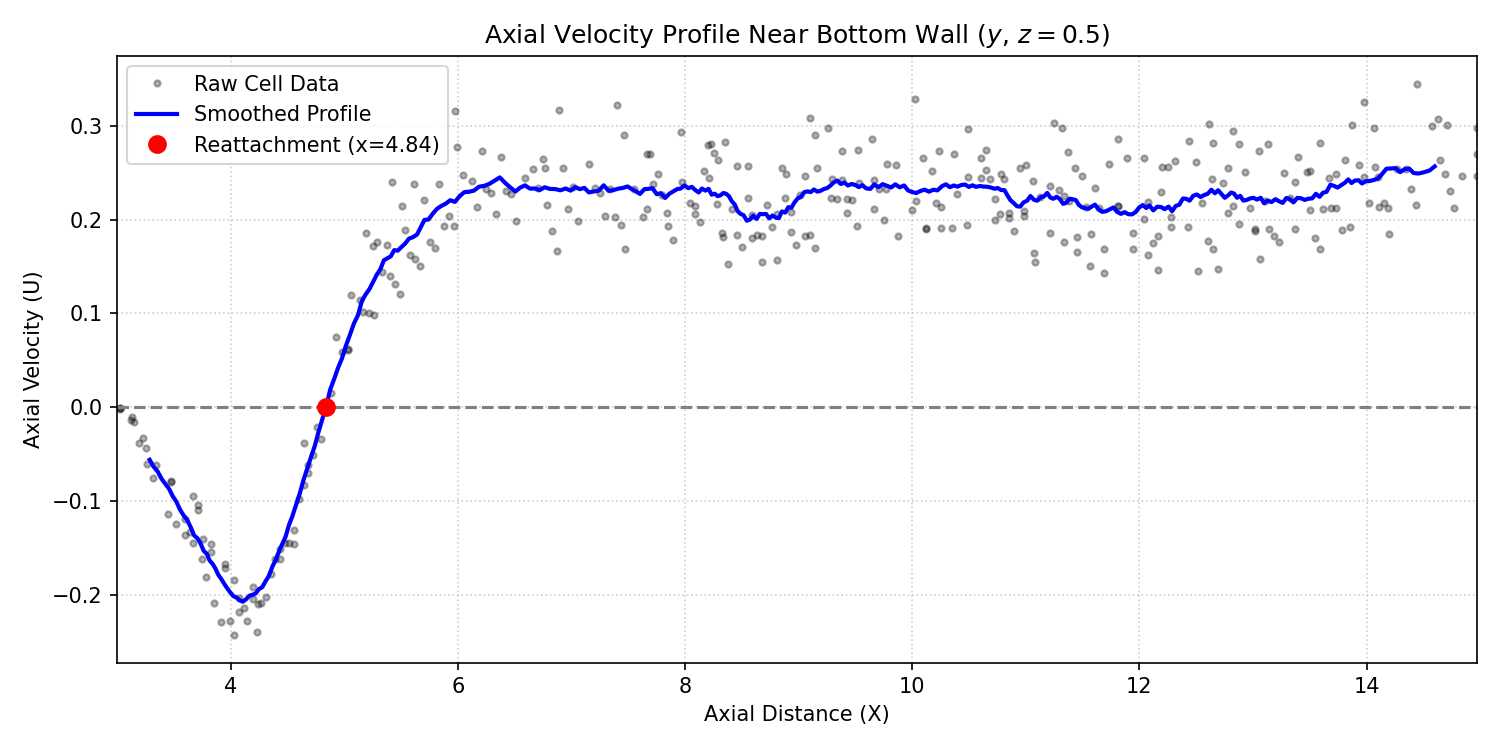
Validates flow separation, reattachment, and recirculation dynamics. When fluid passes over a sudden step expansion, shear layers break off and form a long, closed recirculation bubble downstream.
Result: The primary reattachment bubble length computed by the AeroFlux SIMPLE segregated solver perfectly matches established experimental data by Armaly et al. (1983), verifying momentum separation accuracy.
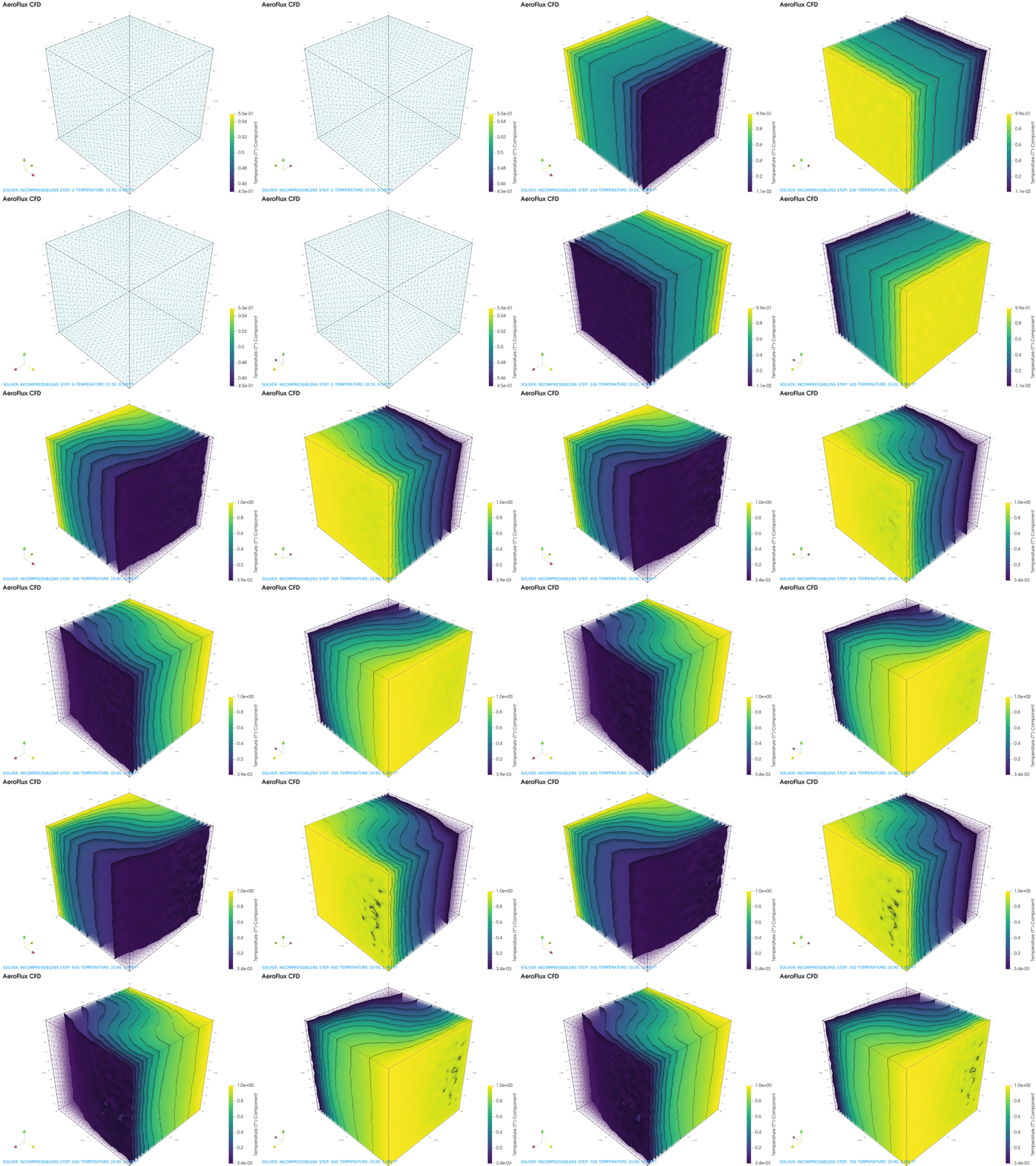
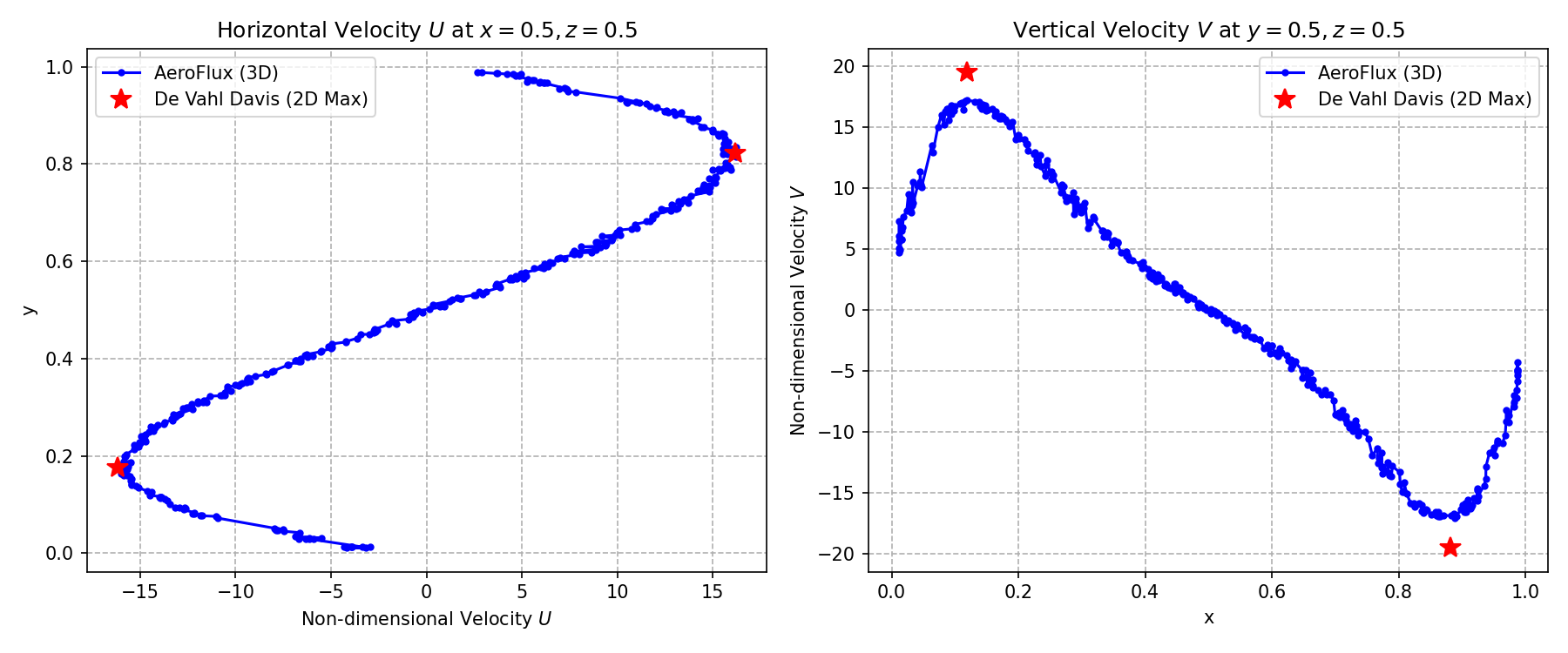
Showcases Boussinesq buoyancy coupling. A closed cavity with heated and cooled side walls drives a strong convection flow circuit against the vertical gravity vector solely due to density differences.
Result: Velocity profiles and local Nusselt numbers along the boundary align tightly with the benchmark computations of De Vahl Davis (1983), proving the accuracy of the multi-physics thermal-fluid coupling loop.
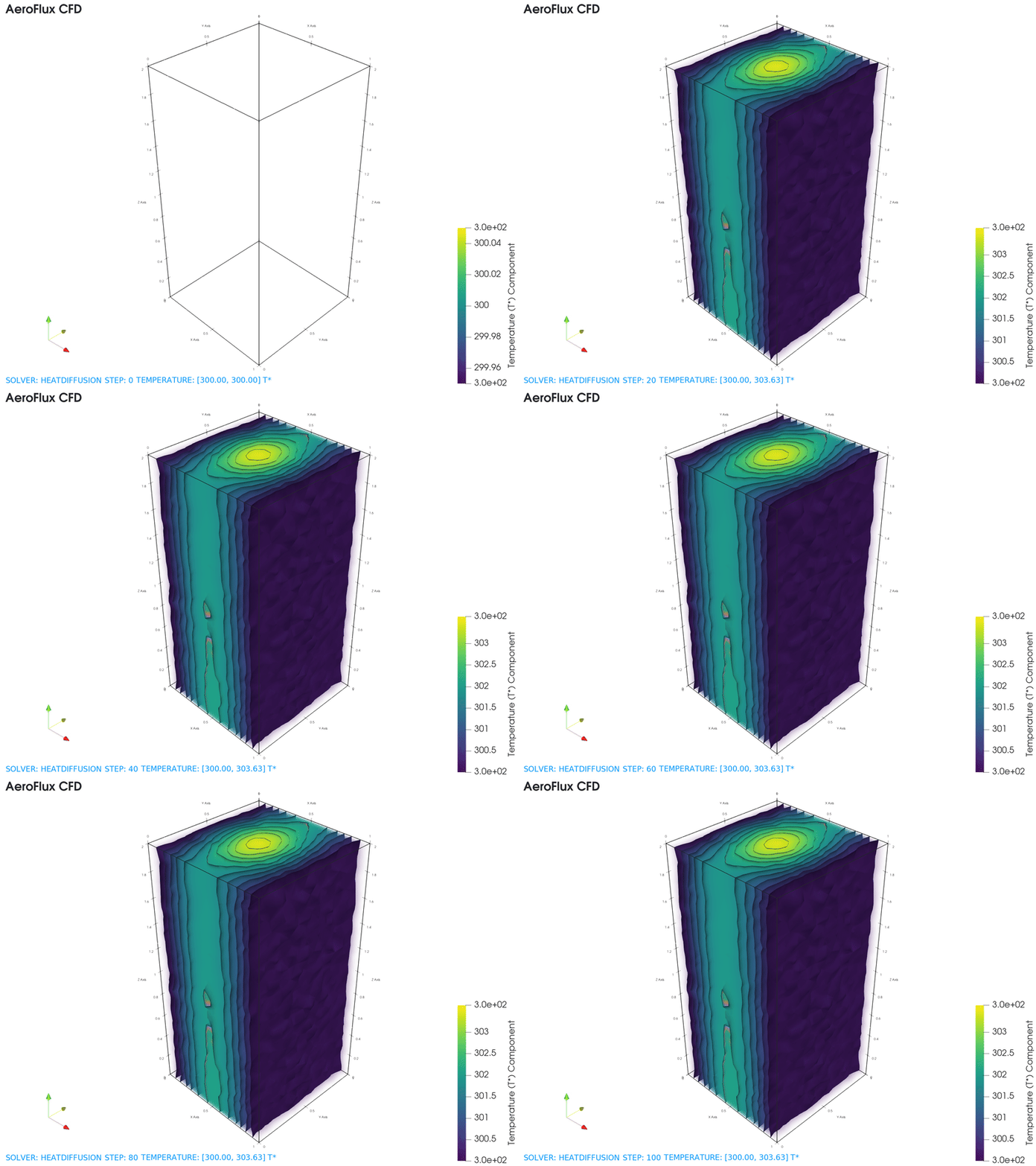
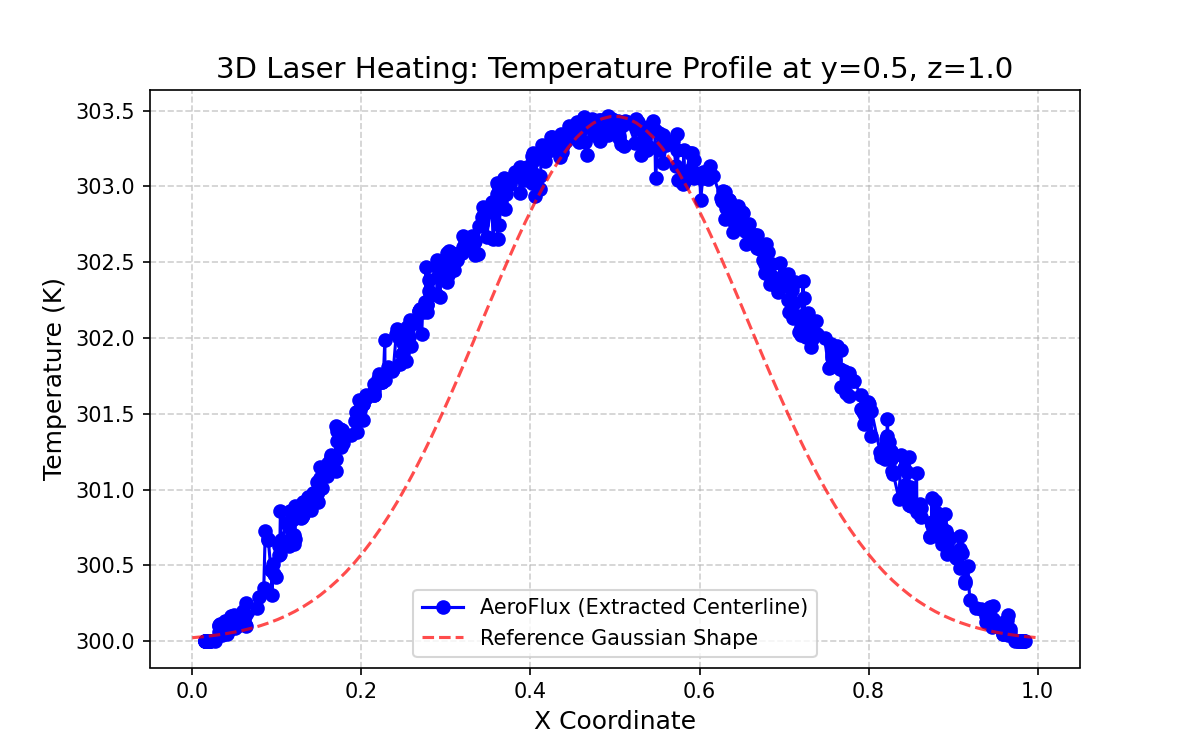
Validates unsteady second-order diffusion solvers using an active, time-dependent spatial Gaussian heat source representing a moving high-intensity laser pulse over a domain.
Result: The transient thermal profiles correspond precisely to the analytical integration values, demonstrating temporal accuracy in the implicit time-marching schemes.
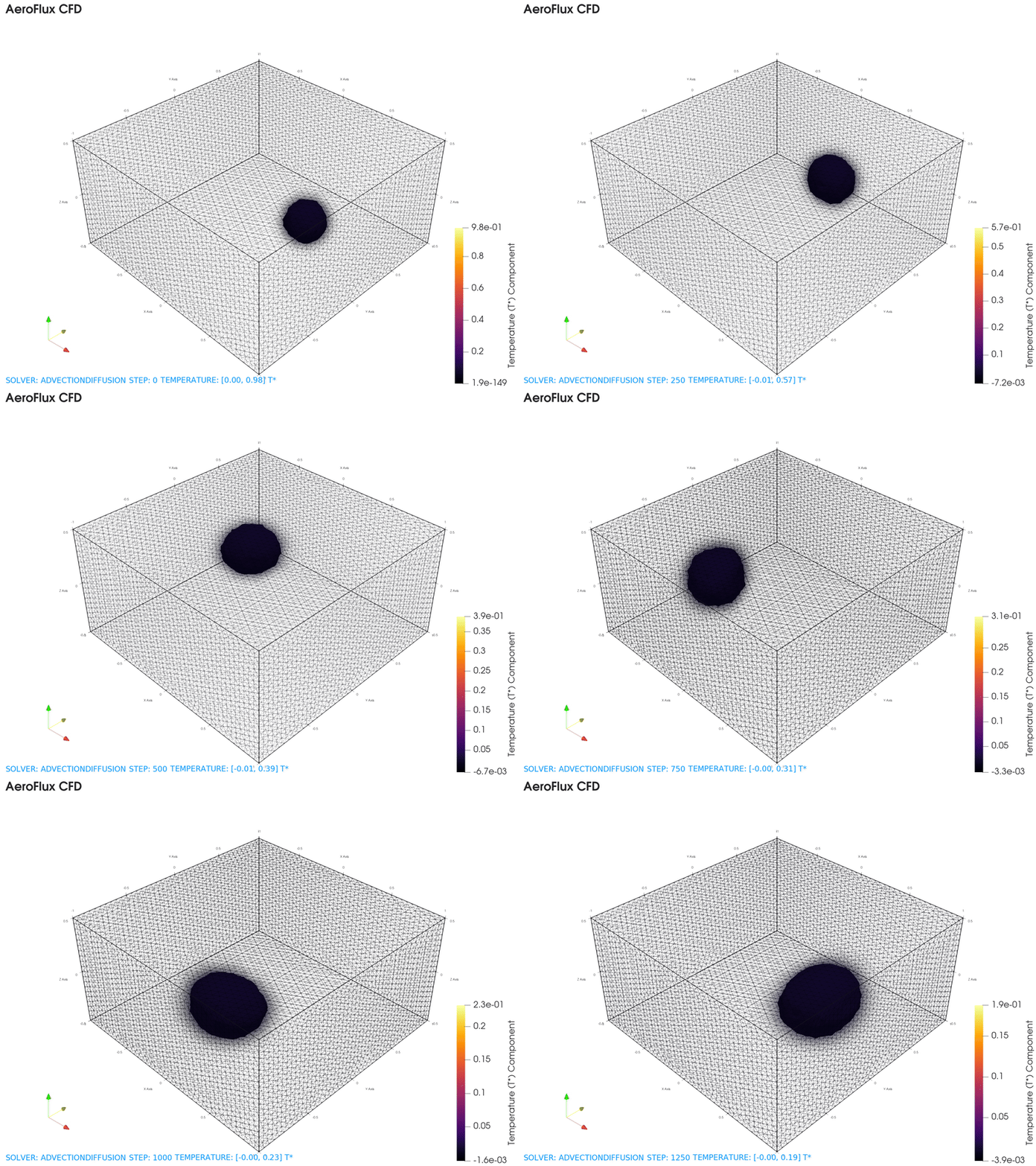
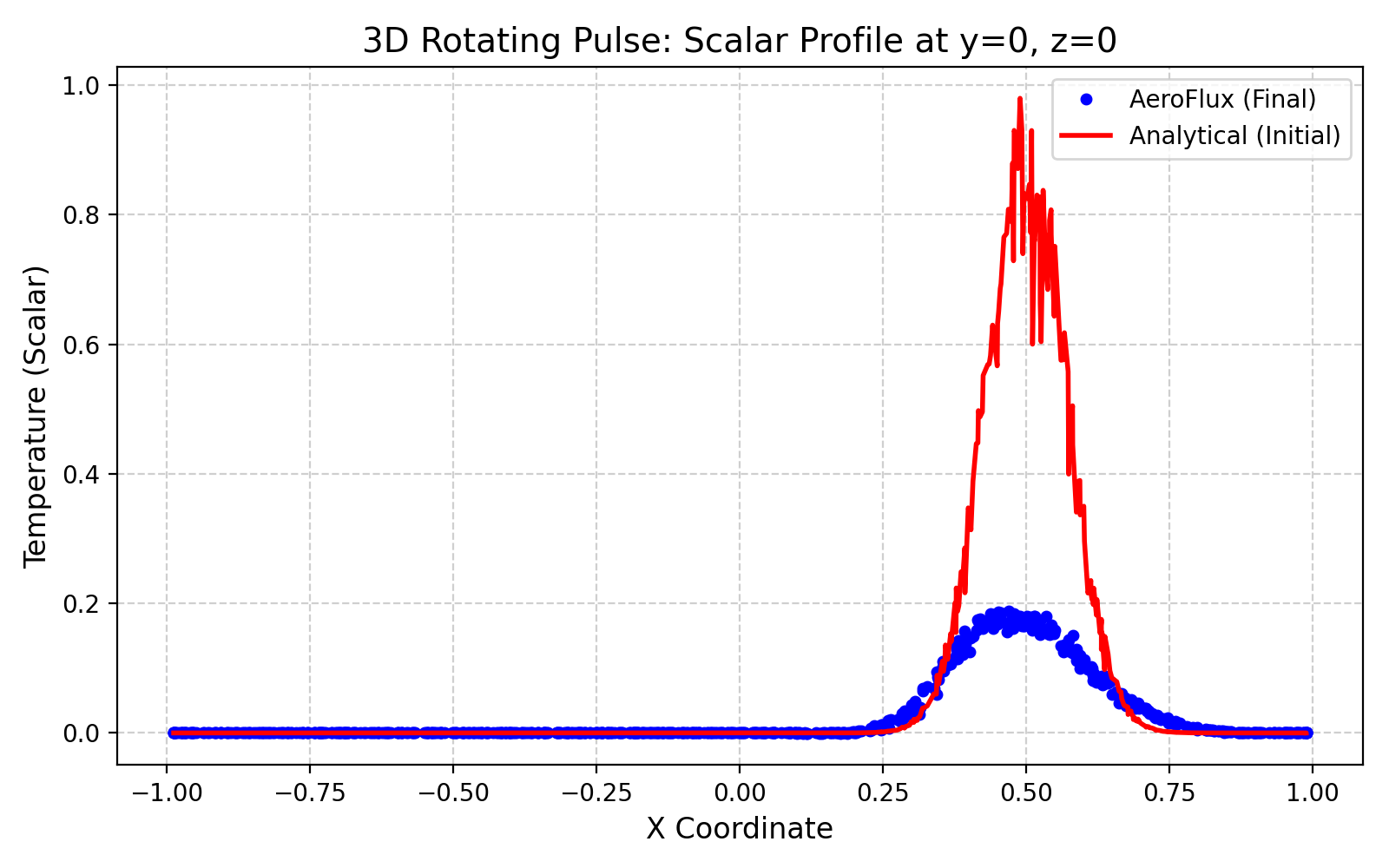
A rigorous test for numerical advection schemes. A complex spatial shape is subjected to a constant solid-body rotational velocity field over a full $2\pi$ cycle on unstructured tetrahedral meshes.
Result: High-order reconstruction paired with the Superbee flux limiter prevents both unphysical numeric dispersion (wiggles) and high numeric diffusion (smearing), keeping the sharp pulse boundaries intact.
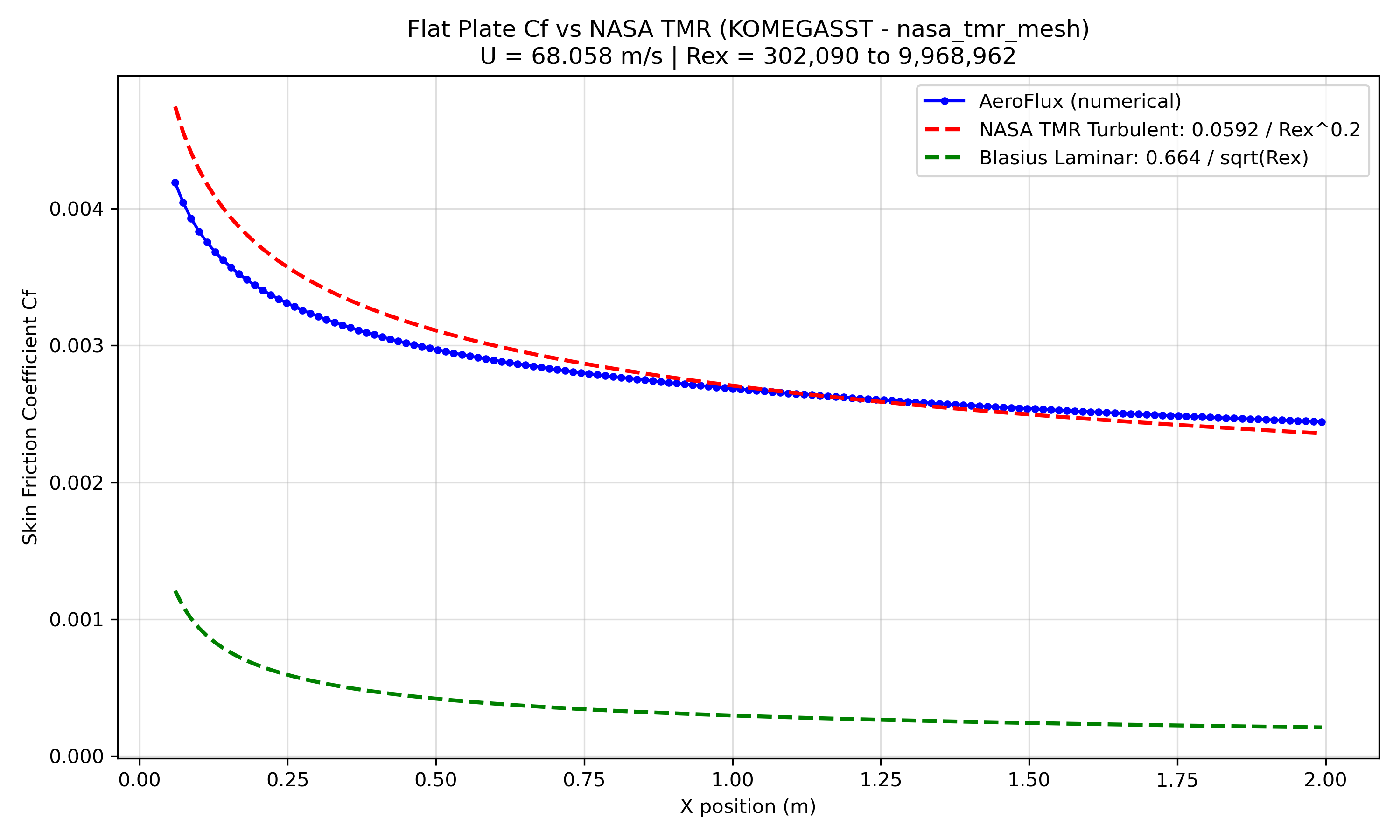
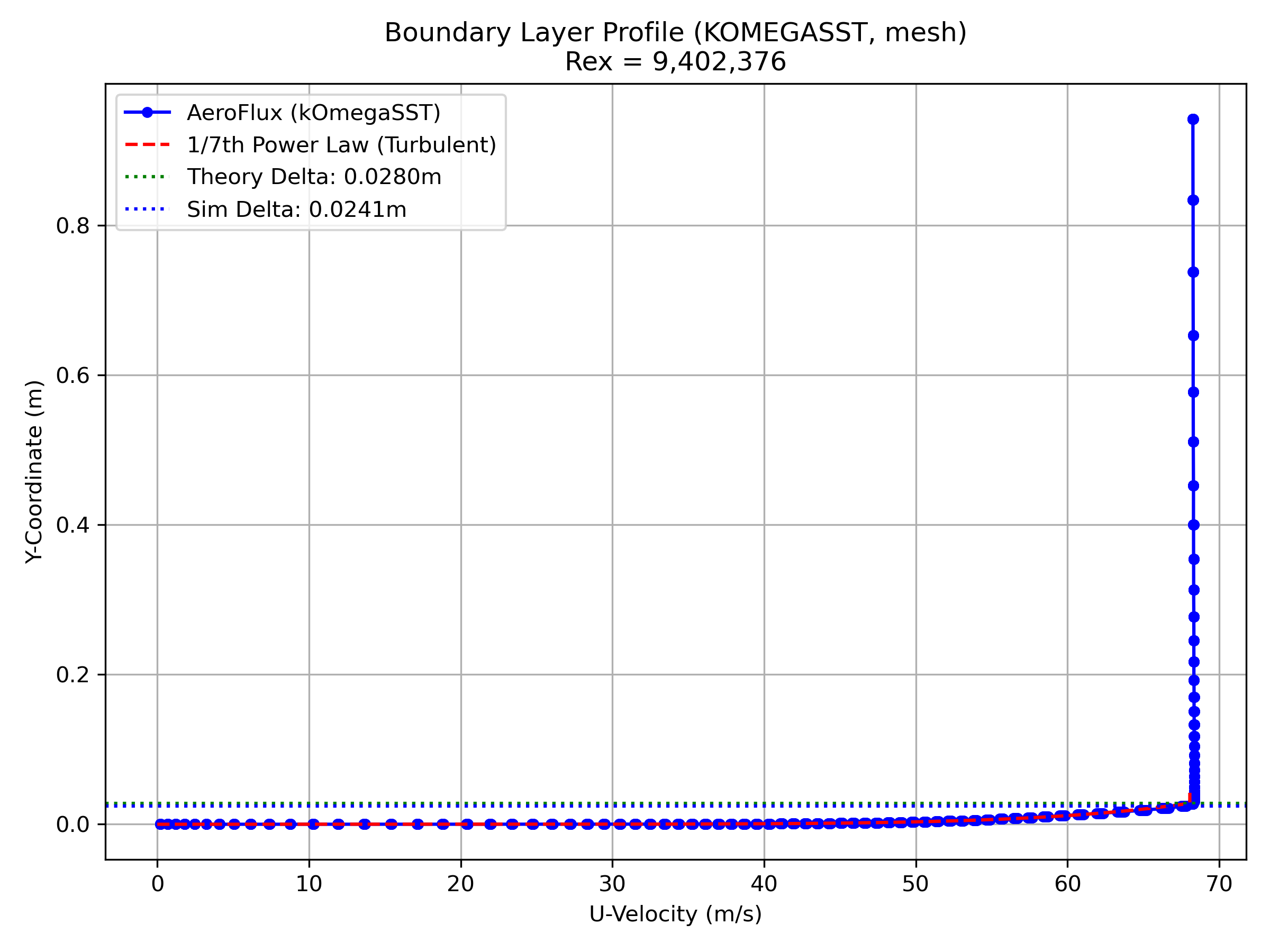
Validates high-Reynolds turbulent boundary layers resolved down to the viscous sublayer ($y^+ < 1$) along a flat plate. Results are compared directly to NASA's Turbulence Modeling Resource (TMR) database.
Result: AeroFlux computes local skin friction coefficients ($C_f$) with an outstanding **mean validation error of only 3.21%** compared to the empirical Schlichting/White correlations at steady state. Wall boundary scaling behaves identically to wall functions without singularities.
Showcases Boussinesq buoyancy coupling in a transient simulation of a 2D thermal candle plume. This case compares the thermal convection and plume bending between a baseline 0 m/s scenario and a 0.01 m/s cross-wind perturbation.
Result: AeroFlux accurately captures the flow separation, thermal advection, and the highly transient vortex shedding introduced by the subtle cross wind interacting with the buoyancy-driven plume.
Deploy and run parallel simulations on your workstation or compute cluster with a clean config structure.
# Clone and build the parallel C++ FVM engine
git clone https://github.com/sachiniitbae/AeroFlux-CFD.git
cd AeroFlux-CFD && make parallel -j$(nproc)

# Launch Lid-Driven Cavity using 4 MPI ranks
mpirun -np 4 ./bin/aeroflux_parallel -config configs/cavity_3d.yaml

# Run the high-fidelity rendering pipeline to produce XDMF and PNGs
python3 scripts/render_parallel.py --input output/cavity_3d.h5
# Run the automated sandbox script to configure PETSc with GPU acceleration
bash scripts/setup_petsc_gpu.sh --backend=cuda --prefix=/usr/local/petsc-gpu
# Compile the solver with active device-offload calls
make parallel-gpu -j$(nproc)
# Run the GPU-preconditioned simulation (BiCGStab solver, HYPRE on device)
mpirun -np 8 ./bin/aeroflux_parallel -config configs/thermal_3d.yaml -vec_type cuda -mat_type aijcudasimulation:
name: "3D Cavity Flow Re=1000"
solver: "piso" # transient pressure-velocity coupling
time_steps: 1000
dt: 0.005
physics:
viscosity: 0.001
density: 1.0
gravity: [0.0, 0.0, -9.81]
mesh:
file: "meshes/cavity_structured_32.msh"
format: "msh2"
linear_solver:
pressure:
solver: "cg"
preconditioner: "gamg" # Geometric-Algebraic Multigrid
tolerance: 1e-7AeroFlux is fully open source, customizable, and ready for integration into your aerospace or thermal design workflows.